Views: 0 Author: Site Editor Publish Time: 2026-11-19 Origin: Site
A frozen food processing facility experiences a recurring problem.
The refrigeration system has sufficient compressor capacity. The evaporators were selected for the required operating temperatures, and the fans provide adequate airflow when the coils are clean.
Yet after several hours of production, the cooling performance begins to deteriorate.
Frost accumulates between the fins. Airflow decreases. Product freezing times become longer, and the refrigeration system struggles to maintain the required conditions.
The operators respond by increasing defrost frequency.
That restores performance temporarily, but it also reduces productive refrigeration time and introduces additional heat into the refrigerated space.
The problem is no longer simply about cooling capacity.
It is about how effectively the evaporator can alternate between refrigeration and defrost operation.
In industrial refrigeration, defrost design is part of the heat exchanger design—not an accessory to be selected after the evaporator has been manufactured.
The appropriate defrost method depends on the room temperature, moisture load, refrigerant system, coil construction, operating schedule, and available utilities.
Choosing the wrong method can result in incomplete defrosting, excessive energy consumption, unnecessary downtime, or repeated ice formation.
When an evaporator operates with a coil surface temperature below the freezing point of water, moisture from the surrounding air can accumulate as frost.
The moisture may originate from several sources:
Air infiltration through doors and openings
Warm or humid products entering the refrigerated space
Food processing and washing operations
Personnel and equipment movement
Moisture released during cooling or freezing
Inadequately controlled humidity in adjacent areas
As frost accumulates, it changes the thermal and aerodynamic behavior of the heat exchanger.
Initially, a thin frost layer may have a limited effect on operation.
As the layer becomes thicker, however, it adds thermal resistance and restricts the airflow passages between the fins.
The resulting increase in air-side pressure drop can move the fans away from their intended operating point.
Reduced airflow then decreases the evaporator's ability to transfer heat.
In severe cases, frost can block substantial portions of the coil.
The purpose of defrost is to remove this accumulation before it compromises refrigeration performance.
But the objective is not simply to melt visible ice.
A successful defrost system must also allow meltwater to drain away and prevent it from refreezing in critical locations.
Several defrost methods are used in industrial refrigeration.
The most common options include:
Electric defrost
Hot gas defrost
Water defrost
Hot glycol or other heated secondary-fluid defrost
Off-cycle or air defrost
Each method introduces heat into the evaporator differently.
Each also has distinct implications for equipment construction, controls, energy consumption, and maintenance.
There is no universally superior method.
The best choice is the one that meets the project's operational requirements with acceptable reliability, complexity, and lifecycle cost.
Electric defrost is widely used in commercial and industrial unit coolers.
Electrical resistance heaters are installed within or around the evaporator assembly.
During defrost, the refrigeration supply is interrupted and the heaters are energized.
Heat is transferred to the coil and associated components, melting accumulated frost.
Additional heaters may be installed in the drain pan and drainage system.
Electric defrost is relatively straightforward to integrate into many refrigeration systems.
It does not require a hot gas supply or a separate heated-fluid circuit.
The control sequence can also be relatively simple.
For smaller and medium-sized cold room evaporators, these characteristics make electric defrost an attractive option.
Other advantages include:
Independent control of individual evaporators
Relatively straightforward electrical installation
Compatibility with several refrigerant systems
Flexible heater arrangement
Convenient integration with automatic defrost controls
The principal disadvantage is electrical energy consumption.
Electric heaters generate heat directly, and not all of that heat contributes to melting frost.
Some energy warms the coil metal, casing, drain pan, and surrounding air.
After defrost, the refrigeration system must remove much of this added heat.
For large industrial evaporators, the installed heater power can become substantial.
There are also mechanical considerations.
Poor heater positioning can produce uneven heating, leaving frost in areas that receive insufficient energy.
Heaters must be installed so that they can operate safely and be maintained or replaced when necessary.
Electric defrost is often suitable for:
Small and medium frozen storage rooms
Applications with moderate frost accumulation
Installations without a practical hot gas supply
Projects requiring independent evaporator control
Refrigeration systems where electrical simplicity is a priority
For very large coils or facilities with heavy and frequent frost accumulation, the total electrical demand and defrost duration deserve closer examination.
Hot gas defrost is widely used in industrial refrigeration systems, particularly in large low-temperature installations.
Instead of relying on electrical resistance heaters, the system directs appropriately controlled hot refrigerant gas into the evaporator.
The refrigerant releases heat as it cools and, where applicable, condenses within the coil.
This heat melts the accumulated frost.
Hot gas defrost is commonly associated with industrial ammonia systems, although it can also be used with other refrigerants when the system is specifically designed for it.
The method uses heat available within the refrigeration system rather than relying entirely on dedicated electrical resistance heating.
For large evaporators, this can provide effective heat transfer through the internal refrigerant passages.
It may also reduce the need for extensive electric heating elements within the coil.
However, hot gas defrost is not free energy.
Its overall energy impact depends on the refrigeration system configuration, compressor operation, control strategy, defrost duration, and heat balance.
Hot gas defrost requires considerably more attention to refrigerant piping and control.
The design must account for:
Hot gas supply pressure and temperature
Refrigerant flow distribution
Condensate drainage
Pressure equalization
Valve sequencing
Liquid management
Thermal expansion
Safe transition back to refrigeration
Improperly designed hot gas defrost systems can experience serious operational problems.
These may include excessive pressure differentials, liquid-related pressure transients, and mechanical stress.
In industrial ammonia installations, the control sequence and piping arrangement should be engineered according to the applicable refrigeration safety standards and system requirements.
Hot gas defrost is often considered for:
Large ammonia refrigeration systems
Industrial frozen storage facilities
Low-temperature processing installations
Projects with multiple large evaporators
Facilities where centralized defrost management is practical
Its suitability depends on the complete refrigeration system, not just the evaporator itself.
Water defrost uses water distributed over the evaporator coil to melt accumulated frost.
Water transfers heat effectively to icy surfaces, making it attractive for certain industrial applications.
It can be particularly useful where frost accumulation is substantial and a relatively short defrost period is required.
During the defrost sequence, refrigeration is stopped and water is delivered through a distribution arrangement.
The water flows over the coil, transferring heat to the frost.
The resulting meltwater drains into a collection system.
The design must ensure that water reaches the required surfaces without creating unacceptable leakage, splashing, or drainage problems.
A common misconception is that water defrost requires very hot water.
In practice, moderately warm water can be effective because water has a relatively high heat capacity and transfers heat efficiently when properly distributed.
For some industrial applications, water in approximately the 20–35°C range may be considered as an initial design reference.
However, there is no universal water defrost temperature suitable for every evaporator.
The required temperature depends on frost thickness, water flow, coil dimensions, defrost duration, and equipment construction.
The final temperature must also be compatible with the coil materials, coatings, seals, and drainage components.
Higher water temperature does not automatically mean better overall operation.
Excessively hot water may increase thermal stress, introduce unnecessary heat into the refrigerated space, or create problems for temperature-sensitive materials.
Water defrost can provide:
Effective heat transfer to frost-covered surfaces
Potentially short defrost cycles
Good suitability for some large industrial coils
An alternative to extensive electrical heating
Practical integration where an appropriate water supply is available
Water defrost also introduces additional engineering requirements.
The system needs adequate water supply, distribution, collection, and drainage.
Water quality must be considered.
Mineral deposits, contamination, or poor drainage can create maintenance and hygiene problems.
In low-temperature rooms, residual water may refreeze after the defrost cycle.
This can cause ice accumulation in the drain pan, around the casing, or on nearby surfaces.
The evaporator must therefore be designed for controlled water distribution and complete drainage.
Water defrost may be appropriate for:
Certain blast freezing applications
Large industrial evaporators with heavy frost accumulation
Facilities with suitable water and drainage infrastructure
Equipment designed specifically for water defrost
Processes where defrost duration is a major operational concern
It is less attractive where water management, hygiene, drainage, or refreezing risks cannot be adequately controlled.
Hot glycol defrost uses a heated secondary fluid to transfer heat into the evaporator coil.
The fluid may be ethylene glycol, propylene glycol, or another suitable heat transfer medium.
This approach is particularly relevant to installations that already use a secondary-fluid refrigeration system.
During refrigeration, a cold secondary fluid circulates through the evaporator.
For defrost, the control system changes the operating mode so that a warmer fluid is circulated through the appropriate heat exchanger passages.
The warm fluid transfers heat through the tube walls, melting frost on the external surfaces.
The exact hydraulic arrangement depends on the system design.
Some installations use dedicated defrost circuits or separate fluid distribution arrangements.
Others use controlled switching between cold and warm fluid supplies.
Hot glycol defrost can offer several benefits:
No need to route hot refrigerant gas into the air cooler
Potential integration with existing secondary-fluid infrastructure
Controlled heating through the coil tubes
Reduced dependence on electric coil heaters
Flexibility in heat source selection
For facilities with an available warm-fluid circuit, the method may be particularly attractive.
Glycol defrost is not simply a matter of circulating warm liquid through a cold coil.
The design must consider:
Glycol concentration
Fluid viscosity
Flow rate
Supply temperature
Return temperature
Hydraulic pressure drop
Thermal expansion
Valve arrangement
Heat exchanger compatibility
Defrost duration
Glycol concentration affects both freezing protection and heat transfer performance.
Increasing glycol concentration generally reduces the risk of freezing but also changes viscosity, heat capacity, and pumping requirements.
The correct concentration should be selected for the lowest relevant operating temperature and the fluid manufacturer's specifications.
Hot glycol defrost may be suitable for:
Industrial glycol refrigeration systems
Facilities with available warm secondary-fluid circuits
Applications requiring an alternative to hot gas defrost
Projects where electrical heater demand is undesirable
Custom industrial evaporators designed for secondary-fluid operation
Its economic attractiveness depends heavily on the available heat source and the additional pumping and piping requirements.
Off-cycle defrost is the simplest method in principle.
The refrigeration supply is stopped while the evaporator is allowed to warm sufficiently for frost to melt.
In suitable applications, room air provides the heat required for defrost.
Off-cycle defrost requires little additional heating equipment.
It can reduce electrical complexity and may be energy-efficient in applications where the surrounding air is warm enough to melt frost.
The method is generally unsuitable for conventional frozen storage rooms operating below 0°C.
When the room air itself remains below freezing, stopping refrigeration does not provide a reliable heat source for melting accumulated ice.
Off-cycle defrost is therefore primarily associated with suitable above-freezing applications.
These may include:
Certain chilled food storage rooms
Above-freezing processing areas
Applications with relatively light frost formation
Installations where the evaporator can warm above freezing during the off-cycle
The method must be evaluated against room temperature, product requirements, and the time available for defrost.
The following table provides a general engineering comparison.
Defrost method |
Main heat source |
Typical suitability |
Main consideration |
|---|---|---|---|
Electric |
Resistance heaters |
Small to medium freezers and cold rooms |
Electrical demand and heater arrangement |
Hot gas |
Refrigerant heat |
Large industrial refrigeration systems |
Piping, valves, controls, and refrigerant safety |
Water |
Supplied water |
Selected heavy-frost industrial applications |
Water distribution, drainage, and refreezing |
Hot glycol |
Heated secondary fluid |
Glycol systems and custom applications |
Fluid circuit, pumping, and heat source |
Off-cycle |
Room air or ambient heat |
Suitable above-freezing rooms |
Limited effectiveness below freezing |
This table is a starting point rather than a selection rule.
For example, a large industrial freezer may use electric defrost successfully when the equipment and electrical infrastructure are designed accordingly.
Similarly, water defrost is not automatically preferable to hot gas defrost in every blast freezing application.
The final decision should reflect the refrigeration system and operating requirements.
It is tempting to select defrost equipment using a simple rule:
Above freezing: off-cycle defrost.
Below freezing: electric or hot gas defrost.
Although room temperature is important, this approach is incomplete.
Consider two rooms operating at −25°C.
The first stores frozen packaged products and has limited door openings.
The second receives frequent deliveries and experiences substantial moisture infiltration.
Both rooms have the same design temperature, but their frost loads may be very different.
The second application may require more frequent defrost, different fin spacing, or a more robust drainage arrangement.
Now consider a blast freezer operating at −35°C.
Its moisture load may be influenced by warm incoming products, process conditions, and the duration of each freezing cycle.
The defrost strategy should account for production scheduling as well as refrigeration performance.
The operating environment determines how much frost forms. The defrost system determines how effectively that frost can be removed.
Both must be considered during equipment selection.
Blast freezers and spiral freezers place particularly demanding requirements on evaporator design.
These applications commonly operate at low air temperatures while handling substantial product loads.
Depending on the process, the incoming products may release significant moisture.
This can produce rapid frost accumulation on the evaporator.
In a conventional storage room, defrost may be scheduled around relatively stable refrigeration demand.
In a production freezer, defrost can directly affect throughput.
If the evaporator requires frequent or lengthy defrost cycles, productive freezing time decreases.
This can create a bottleneck even when the clean-coil cooling capacity appears sufficient.
The design must therefore consider:
Production cycle duration
Product moisture load
Expected frost accumulation
Available defrost windows
Required recovery time
Coil geometry and fin spacing
Fan operation during refrigeration
Drainage and residual water management
A heavily frosted coil cannot always be restored efficiently by increasing heater power or water temperature.
If the fin arrangement prevents effective heat distribution or drainage, defrost may remain incomplete.
For demanding freezing applications, the evaporator should be designed as a complete system.
This includes the heat exchanger, fan arrangement, defrost equipment, drain pan, casing, and control requirements.
A well-designed defrost system should remove frost effectively without introducing unnecessary thermal or mechanical stress.
Defrost systems are often controlled using a timer.
A fixed interval initiates defrost, and the system operates for a predetermined duration.
This approach is simple, but actual frost accumulation varies with operating conditions.
On some days, the coil may require relatively little defrost.
On others, moisture infiltration or production activity may produce much heavier frost.
A fixed defrost duration may therefore be longer or shorter than necessary.
Temperature sensors can be used to determine when relevant parts of the evaporator have reached a suitable termination condition.
This may help avoid unnecessary heating after frost removal.
However, sensor placement is critical.
A sensor located in a warm area of the coil may indicate completion while frost remains elsewhere.
More advanced systems may use operating data to determine when defrost is required.
Potential indicators include:
Air pressure drop
Coil temperature behavior
Refrigeration performance trends
Operating time
Airflow changes
Demand-based defrost can reduce unnecessary cycles in suitable installations.
However, it requires reliable sensors, appropriate control logic, and an understanding of the evaporator's operating behavior.
It should not be assumed that every industrial application benefits equally from the additional complexity.
An evaporator may have an effective coil defrost system and still experience serious ice problems.
One common cause is inadequate drainage.
During defrost, meltwater must leave the coil and drain pan before the refrigeration cycle resumes.
If water remains in low points or poorly drained sections, it may refreeze.
Repeated cycles can gradually build up ice.
Eventually, this ice can interfere with airflow, damage components, or obstruct drainage.
The drain pan should provide an appropriate slope and drainage path.
In low-temperature installations, drain pan heating and drain line freeze protection may be required.
Water defrost systems need particular attention to the volume and distribution of meltwater.
For large industrial evaporators, access for cleaning and maintenance should also be considered.
The best defrost method cannot compensate for a fundamentally inadequate drainage arrangement.
Defrost introduces heat into a refrigerated environment.
Some of this heat is necessary to melt frost.
Additional energy may be required to warm the coil, casing, drain pan, and other components.
After defrost, the refrigeration system must remove much of the added heat.
Therefore, the energy impact includes more than the direct energy used by the defrost equipment.
A useful lifecycle evaluation considers:
Total defrost-related energy = Defrost energy input + Additional refrigeration energy + Relevant auxiliary energy
This is a conceptual relationship. Actual energy accounting must avoid double-counting heat transfers and must reflect the system boundary being evaluated.
For electric defrost, direct heater consumption is relatively easy to measure.
For hot gas defrost, the energy impact is distributed across the refrigeration system.
For water defrost, water heating, pumping, treatment, and subsequent refrigeration load may all be relevant.
For hot glycol defrost, the heat source and fluid circulation system must be considered.
The most energy-efficient solution is not necessarily the method with the lowest direct electrical heater consumption.
It is the method that achieves reliable frost removal with the lowest practical total energy and operating cost.
Several problems appear repeatedly in industrial evaporator installations.
The defrost method may require specific tube arrangements, heater locations, water distribution systems, or casing features.
It should be considered early in the design process.
Higher temperature does not always produce better overall performance.
Excessive heating can increase thermal stress and introduce unnecessary heat into the refrigerated space.
Incomplete drainage can cause recurring ice accumulation even when the coil itself is fully defrosted.
Evaporators in different locations may experience different moisture loads.
Uniform scheduling can result in unnecessary defrosting or incomplete frost removal.
Insufficient drainage or poorly managed restart sequences may allow residual water to refreeze.
Repeated temperature changes, water exposure, and cleaning chemicals can affect coatings, seals, and structural components.
The defrost process must be compatible with the evaporator's construction.
Industrial refrigeration projects rarely have identical operating conditions.
A frozen storage room, a meat processing facility, and a spiral freezer may all use industrial evaporators, but their frost formation and defrost requirements can be substantially different.
At STELX, evaporator design can be adapted to the specific refrigeration application.
Customization may include:
Electric heater arrangements
Water defrost distribution systems
Hot gas defrost-compatible coil configurations
Heated glycol defrost arrangements
Drain pan and drainage construction
Tube and fin material selection
Fin spacing and coil geometry
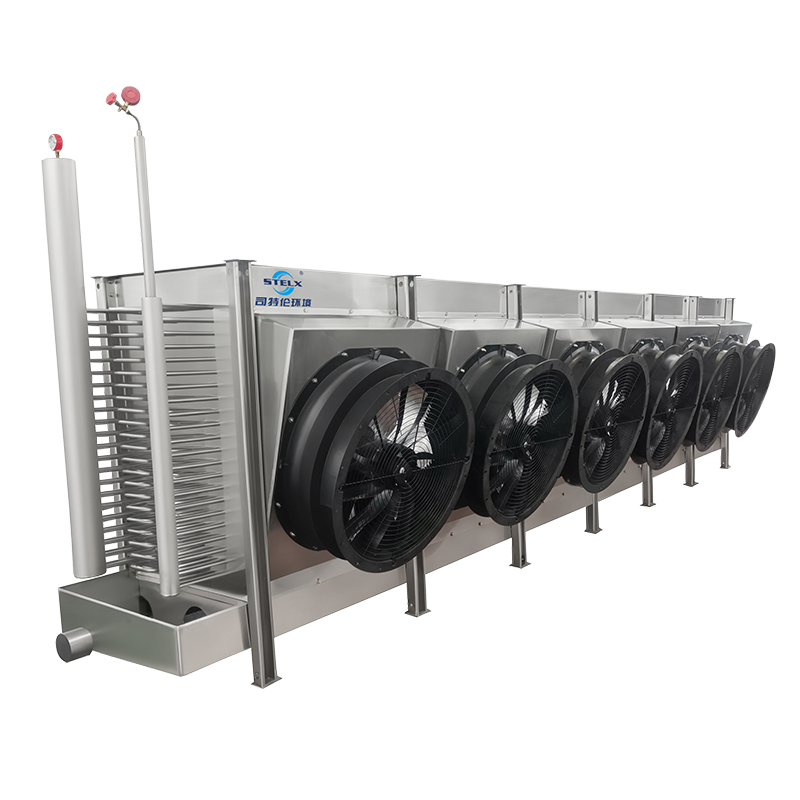
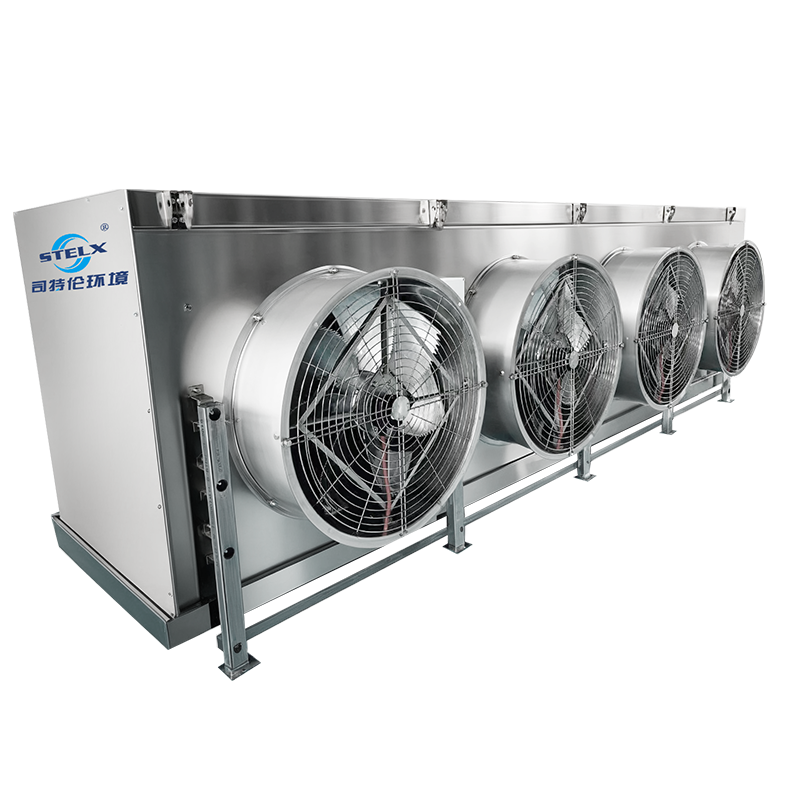
Fan and casing configurations
For example, a low-temperature industrial evaporator designed for frequent defrost cycles may require different construction details from a unit intended for relatively stable frozen storage.
Similarly, an evaporator operating in a corrosive or frequently washed environment may require special material and coating considerations.
The objective is to match the equipment to the actual operating requirements rather than treating defrost as a standard accessory.
When requesting an industrial evaporator quotation, buyers should provide the following information whenever possible.
Design information |
Why it matters |
|---|---|
Room operating temperature |
Determines the available defrost options |
Refrigerant or secondary fluid |
Influences defrost system compatibility |
Product type and moisture load |
Helps estimate frost accumulation |
Production or storage schedule |
Determines available defrost windows |
Door opening frequency |
Indicates potential infiltration load |
Required cooling capacity |
Establishes evaporator duty |
Available electrical supply |
Determines electric heater feasibility |
Hot gas availability |
Determines whether hot gas defrost is practical |
Warm water or glycol availability |
Supports alternative defrost methods |
Hygiene and washdown requirements |
Influences material and drainage design |
Installation dimensions |
Constrains defrost and drainage arrangements |
Preferred control strategy |
Influences sensors and automation |
A supplier may not need every detail for an initial budget quotation.
However, final defrost design should be based on a clear understanding of the operating conditions.
There is no universally best method. Electric, hot gas, water, hot glycol, and off-cycle defrost each have advantages and limitations. The correct choice depends on temperature, moisture load, refrigerant system, operating schedule, utilities, and equipment construction.
It can be advantageous in certain industrial refrigeration systems, particularly where suitable hot gas infrastructure is available. However, total energy performance depends on the system configuration and operating strategy. A direct comparison should include the effect on the complete refrigeration system.
Moderately warm water is often sufficient in appropriately designed water defrost systems. A range around 20–35°C may be considered for some applications, but the correct temperature depends on the coil, frost load, water flow, materials, and required defrost time. It must be verified for the specific equipment.
Yes. Heated glycol or another suitable secondary fluid can be used in specially designed evaporators. The system must provide adequate heat transfer, flow control, pressure management, and freezing protection.
Ordinary air-based off-cycle defrost is generally unsuitable because the surrounding air is below freezing and cannot reliably melt accumulated ice. Another heat source is normally required.
Defrost frequency depends on moisture load, coil geometry, operating temperature, airflow, and production conditions. A fixed schedule may be appropriate for some installations, while others benefit from temperature-based or demand-based control.
Possible causes include inadequate heating, uneven heat distribution, insufficient defrost duration, poor drainage, sensor placement, or an incorrect control sequence. The problem should be diagnosed rather than addressed automatically by increasing defrost temperature.
An industrial evaporator must do more than provide sufficient cooling capacity when its coil is clean.
It must also maintain acceptable performance throughout the operating cycle.
In low-temperature applications, this requires an effective strategy for managing frost accumulation.
Electric defrost offers straightforward integration.
Hot gas defrost can be effective in appropriately designed industrial refrigeration systems.
Water defrost provides strong heat transfer where water management is practical.
Hot glycol defrost offers flexibility in suitable secondary-fluid installations.
Off-cycle defrost remains useful where room temperatures allow it.
Each method has a place.
The correct defrost system is the one that removes frost reliably, minimizes unnecessary interruption, and works safely with the evaporator and refrigeration system as a whole.
That decision should be made during the engineering design stage—not after the equipment has already been selected.
If you are designing a frozen storage facility, blast freezer, spiral freezer, or industrial food processing installation, the defrost system should be evaluated together with the evaporator's thermal and mechanical design.
STELX manufactures customized industrial air coolers and evaporators with configurable refrigerant circuits, heat exchanger materials, fin spacing, fan arrangements, casing structures, and defrost systems.
Send us your operating temperature, refrigerant details, cooling requirements, production schedule, and preferred defrost method. Our engineering team can help develop an evaporator configuration suited to your application.
Website: https://www.stelxtech.com