Views: 0 Author: Site Editor Publish Time: 2026-09-22 Origin: Site
Industrial refrigeration setups carry a massive energy burden across global supply chains today. Continuous fan operation frequently accounts for a disproportionate share of facility power consumption. As global utility rates climb, this constant electrical draw creates severe financial pressure on operational budgets. Facilities managers and engineers face a critical decision point. They must choose between maintaining legacy AC (Alternating Current) systems or upgrading to modern EC (Electronically Commutated) technology. Making the right choice directly impacts immediate capital budgets and long-term operating expenses.
We provide an objective, evidence-based framework in this article. We will evaluate performance metrics, efficiency gains, and practical implementation realities for both fan types. You will gain a clear understanding of how these technologies compare mechanically and financially. This knowledge empowers technical teams to optimize refrigeration strategies. You can reduce parasitic energy loads effectively while maximizing your operational returns.
EC technology significantly reduces power consumption during part-load operations compared to traditional AC options.
The higher initial capital expenditure (CapEx) of EC fans is typically offset by operational expenditure (OpEx) savings within 12 to 24 months, depending on duty cycles.
Integrated variable speed control in EC motors eliminates the need for external Variable Frequency Drives (VFDs).
Retrofitting an existing industrial air cooler requires careful assessment of physical dimensions, wiring infrastructure, and control system compatibility.
Industrial cooling requires moving massive volumes of air continuously through dense heat exchangers. Standard AC induction motors typically drive older legacy systems. Manufacturers commonly use shaded pole or permanent split capacitor (PSC) designs for these applications. These motors rely directly on the electrical grid frequency to operate. They synchronize their magnetic rotation based on incoming alternating current. However, this older design creates inherent energy losses. They experience magnetic "slip" during standard operation. This slip generates excess heat instead of driving mechanical motion. You lose valuable electrical energy to the surrounding air constantly.
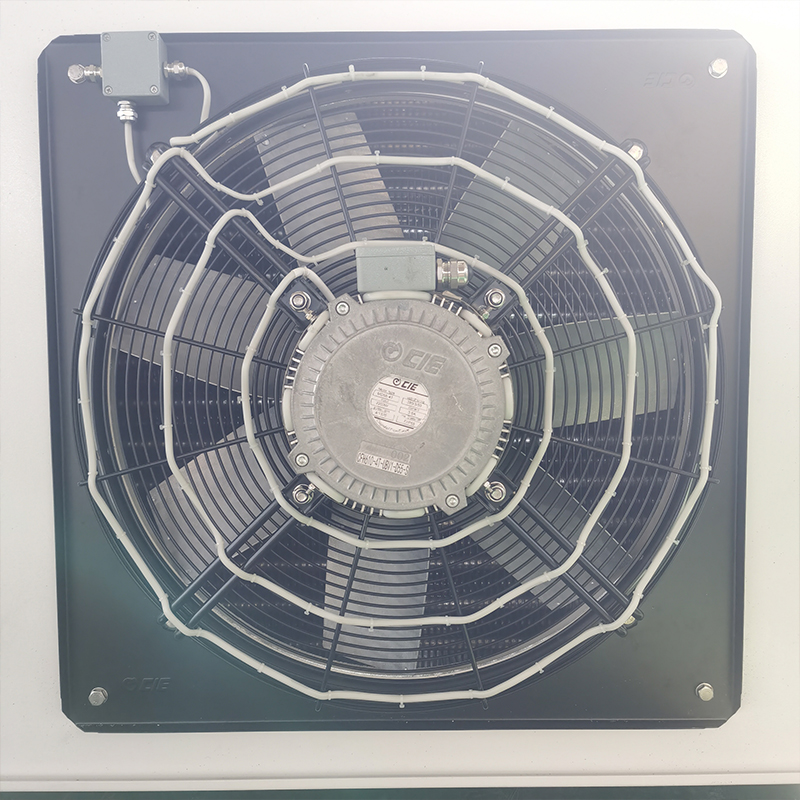
Electronically Commutated (EC) architecture offers a fundamentally different engineering approach. Engineers define EC motors as brushless DC motors. They feature built-in AC-to-DC conversion modules internally. Onboard electronics manage the internal magnetic field dynamically and precisely. They deliver precise rotor control regardless of incoming grid frequency fluctuations. This modern design eliminates traditional physical brushes completely. It removes mechanical friction from the commutation process.
The aerodynamic profile of Axial Fans matters deeply in refrigeration environments. You must push high-velocity air across dense condenser coils efficiently. You also pull air through highly restrictive evaporator fins. Blade shape determines how effectively air penetrates these physical barriers. Matching the right motor commutation to an optimized axial impeller maximizes overall cooling performance. You ensure maximum airflow per watt consumed.
Let us discuss peak versus part-load efficiency profiles carefully. AC fans operate reasonably well at full maximum speed. Their efficiency drops drastically outside this narrow optimal load window. They consume almost full power even when spinning at half speed. In contrast, EC axial fans maintain 70% to over 80% efficiency across a wide speed range. They scale energy use linearly alongside actual RPM demands. When facility temperatures drop at night, the fans slow down and save massive amounts of power.
Energy consumption metrics show clear wattage reductions immediately after retrofitting. You can calculate expected energy savings using a straightforward mathematical framework. Follow these operational steps to build your financial ROI equation:
Identify the wattage difference between the existing AC fan and the proposed EC fan at your typical load.
Convert this wattage difference into total kilowatts (kW).
Multiply the kW savings by your facility's annual operating hours.
Multiply the resulting kilowatt-hours (kWh) by your local utility rates to find annual financial savings.
Heat dissipation plays a crucial role inside closed refrigerated environments. AC motors run notoriously hot under continuous load. This excess heat bleeds directly into the refrigerated space. In an EC fan air cooler application, the motor runs much cooler naturally. Less motor heat means your central refrigeration compressor works less. It does not need to remove that parasitic thermal load continually. This physical dynamic creates a powerful secondary efficiency gain for the entire facility.
Chart 1: Power Consumption Profile Comparison
Speed Demand | AC Motor Power Draw (%) | EC Motor Power Draw (%) | Efficiency Gain Outcome |
|---|---|---|---|
100% (Full Load) | 100% | 100% | Minimal (5-10% base efficiency) |
80% (Part Load) | 95% | 51% | Significant OpEx Savings |
50% (Low Load) | 85% | 12.5% | Massive OpEx Savings |
EC fans natively support standard 0-10V analog signals. They also accept Pulse Width Modulation (PWM) inputs out of the box. This onboard capability allows seamless variable speed adjustments dynamically. You match the exact cooling demand of the facility instantly. You never waste power overcooling a space during off-peak hours or colder seasons.
Consider the engineering limitations of pairing legacy AC motors with Variable Frequency Drives (VFDs). VFDs attempt to modulate AC motor speeds artificially by altering frequencies. This combination introduces loud audible motor noise into the workspace. VFDs create harmful harmonic distortion in your main electrical lines. This electrical distortion accelerates physical bearing degradation over time. You also face the added capital cost and physical bulk of the external VFD unit itself.
Building Management System (BMS) integration provides major operational advantages. EC fans communicate via standard Modbus protocols natively. They feed real-time RPM data back to central facility controllers. They track actual energy usage minute by minute accurately. They flag fault data immediately before catastrophic failures occur. This advanced level of compliance and monitoring simplifies large-scale facility management significantly.
Always shield your low-voltage control cables to prevent external signal interference.
Map fan fault codes directly into your central alarm system for faster maintenance response times.
Program a minimum safe RPM threshold to ensure adequate airflow over cooling coils at all times.
Compare mechanical degradation between the two technologies closely. EC fans lack physical carbon brushes entirely. These brushes wear out quickly in traditional DC motors and require replacement. Because EC electronics run significantly cooler than AC stators, internal bearing grease lasts longer. You extend overall bearing life drastically. Cooler operating temperatures directly correlate to fewer mechanical breakdowns across the calendar year.
Outline the realistic maintenance schedules for your facility maintenance teams. AC systems demand frequent physical inspections. You must replace external starting capacitors regularly. You occasionally replace faulty external variable drives. Conversely, EC fans act as a single sealed functional unit. They offer genuine plug-and-play reliability on the active factory floor.
Redundancy and failure modes matter deeply for continuous industrial uptime. Integrated electronics in EC motors provide active built-in software protections. They shut down safely during sudden grid overvoltage events. They detect phase failures instantly to prevent internal winding damage. They monitor thermal overload parameters internally to prevent catastrophic motor fires.
Table 1: Maintenance and Reliability Comparison Matrix
Component Focus | Legacy AC System | Modern EC System |
|---|---|---|
Brushes / Commutator | None (Induction), but highly susceptible to slip heat | None (Electronic commutation), runs exceptionally cool |
Capacitors | Require regular periodic replacement | Integrated smoothly, high lifespan rating |
Overload Protection | Requires external relays and mechanical breakers | Built-in electronic digital monitoring |
Typical Maintenance Effort | High (Greasing, manual component swaps) | Low (Routine visual inspection, cleaning only) |
Physical constraints complicate retrofitting older operational facilities. Form-factor differences often exist between motor generations. Many modern EC replacements look mechanically interchangeable alongside legacy components. However, you must verify structural grid depth closely. You must measure mounting bracket alignments carefully before ordering bulk replacements. A protruding fan motor can block crucial maintenance access doors.
Electrical upgrades bring hidden costs during extensive facility retrofits. Moving to an intelligent EC system often requires pulling new data cables. You need dedicated low-voltage control wiring to utilize variable speed features fully. If you only supply main power, you lose the primary part-load efficiency benefit. Assess your existing cable trays beforehand to ensure adequate routing space.
Assess facility downtime risks diligently. Swapping fans in an active industrial air cooler halts refrigeration temporarily. You must plan localized cooling shutdowns carefully. Food processing plants and pharmaceutical warehouses cannot afford unexpected temperature spikes. Schedule swaps strictly during planned off-peak maintenance windows.
Ignoring the strict IP rating requirements for frequent chemical washdown environments.
Failing to update electrical facility schematics after removing older external motor starters.
Reusing degraded mounting hardware, which causes excess vibration and premature bearing failure.
Engineers must evaluate project parameters carefully before specifying heavy equipment. Every modern facility operates under unique financial and environmental constraints. You must align your hardware choices with operational realities.
Here is when you should stick with traditional AC technology:
Your immediate project faces extremely tight initial capital expenditure budgets.
Applications require simple On/Off operation where 100% constant load remains legally mandatory. Variable speed yields no financial benefit here.
Environments experience severe electrical grid instability frequently. Sensitive onboard EC electronics might fail rapidly without proper external power filtration.
Here is when you must upgrade to EC technology:
Systems handle highly variable thermal loads requiring precise speed modulation daily.
High-uptime facilities operate continuously 24/7. Your energy ROI occurs rapidly under these demanding conditions.
Data centers, large food processing plants, or pharmaceutical warehouses demand strict environmental compliance. Detailed BMS integration remains non-negotiable in these sectors.
The choice between AC and EC technologies shapes facility performance heavily. It is fundamentally a choice between lower initial hardware costs and optimized long-term operating costs. EC technology dominates part-load efficiency metrics entirely. It provides superior control integration while eliminating external hardware dependencies. However, legacy AC motors still serve basic continuous-load applications reliably in specific niche scenarios.
We recommend conducting a site-specific energy audit immediately. Analyze your specific thermal load profiles carefully. Calculate your exact local utility rates against projected annual operating hours. This data-driven approach remains the definitive next step before procurement. Modernizing your industrial refrigeration ensures strict regulatory compliance and protects your bottom line against rising global energy prices.
A: The payback period generally ranges from 1 to 3 years. This timeline depends heavily on your continuous run-time and local electricity costs. Facilities operating 24/7 experience the fastest financial returns. Savings stem directly from energy reductions and secondary cooling load decreases.
A: Yes, you can run them without external controllers easily. Most EC fans default to full maximum speed if they do not detect a 0-10V control signal. However, running them strictly at full speed defeats their primary variable-speed efficiency advantage.
A: EC fans carry specific Ingress Protection (IP) ratings. You must select models rated between IP54 and IP68 for chemical washdown environments. You must verify the exact rating matches your facility cleaning protocols before installation to prevent water damage.
A: High-quality EC motors do not require special external shielding typically. Reputable manufacturers build robust filters directly into the motor housing. These internal components meet standard EMC compliance requirements automatically. They mitigate EMI and RFI interference effectively without requiring extra hardware.