Views: 0 Author: Site Editor Publish Time: 2026-10-18 Origin: Site
A refrigeration engineer receives a specification for a new cold storage facility. The calculated refrigeration load is 100 kW. A supplier offers an industrial evaporator rated at 105 kW.
On paper, the selection looks reasonable.
The evaporator has slightly more capacity than the calculated load, the operating temperatures appear to match, and the equipment fits inside the room.
Yet after commissioning, the room takes longer than expected to reach its design temperature. During periods of heavy product loading, the temperature rises and struggles to recover. The evaporator fans are running, the refrigeration plant is operating, and nothing appears obviously defective.
What went wrong?
In many cases, the problem begins with a misunderstanding of what an evaporator's rated cooling capacity actually represents.
An industrial evaporator does not have one fixed cooling capacity. Its performance depends on the conditions under which it operates.
A capacity figure is meaningful only when the associated temperatures, refrigerant conditions, airflow, frost allowance, and operating schedule are understood.
For industrial refrigeration projects, selecting a unit cooler by matching two numbers—calculated room load and catalogue capacity—is rarely sufficient.
The distinction sounds elementary, but it is one of the most common sources of confusion in refrigeration equipment selection.
A cold room's cooling load represents the heat that must be removed to maintain the required conditions.
The evaporator's cooling capacity represents the rate at which it can absorb heat under a specified set of operating conditions.
These two values must be compatible, but they are determined differently.
A cold room load calculation typically considers several heat sources:
Heat transmission through walls, ceilings, and floors
Warm air entering through doors and openings
Product cooling or freezing requirements
Heat generated by personnel, lighting, and handling equipment
Fan motor heat and other internal electrical loads
Additional process-specific heat gains
The evaporator capacity, meanwhile, depends on factors such as the temperature difference between the air and refrigerant, heat exchanger geometry, refrigerant-side performance, airflow, and the condition of the coil surface.
A room may have a calculated load of 100 kW, but that does not automatically mean a 100 kW catalogue evaporator will deliver 100 kW in the actual installation.
The catalogue rating may have been established at operating conditions that differ substantially from those of the project.
Before selecting an industrial air cooler, the refrigeration load should be broken down into its principal components.
A simplified representation is:
Total refrigeration load = Transmission load + Infiltration load + Product load + Internal load + Other process loads
For a conventional cold storage room, each component may behave differently throughout the day.
Heat enters through the building envelope because the ambient environment is warmer than the refrigerated space.
The basic relationship is:
Q = U × A × ΔT
Where:
Q = heat transfer rate (W)
U = overall heat transfer coefficient (W/m²·K)
A = exposed surface area (m²)
ΔT = temperature difference across the surface (K)
A cold room with well-insulated panels may have a relatively modest transmission load, even when the temperature difference between indoors and outdoors is significant.
However, insulation performance is only one part of the calculation. Thermal bridges, floor construction, door frames, and the surrounding environment can also influence the result.
Air infiltration can become a major load in facilities with frequent door openings.
When warm, humid air enters a low-temperature room, the refrigeration system must remove both sensible heat and moisture-related heat.
Some of that moisture eventually deposits as frost on the evaporator coil.
Consequently, infiltration affects not only the calculated cooling load but also evaporator operation, airflow resistance, and defrost requirements.
This is why two cold rooms with similar dimensions and storage temperatures may require very different evaporator configurations.
One may operate as a relatively static storage room with limited access.
The other may serve as a distribution facility where doors open repeatedly throughout the day.
Their refrigeration requirements should not be treated as equivalent.
Product load is particularly important in food processing, blast chilling, and freezing applications.
Consider the difference between these two operations:
Application A: Frozen products enter a storage room at approximately the required storage temperature.
Application B: Warm products enter a processing room and must be cooled or frozen within a defined period.
Even if the rooms have identical dimensions, their refrigeration loads can differ dramatically.
For product cooling without a phase change, the sensible heat removal can be estimated from:
Q = m × cp × ΔT
Where:
m = product mass (kg)
cp = specific heat capacity (kJ/kg·K)
ΔT = required product temperature reduction (K)
The resulting energy is expressed in kJ. It must then be divided by the available cooling time to obtain the average cooling rate.
For freezing applications, the calculation must also account for latent heat released during the freezing process and the different thermal properties of the product above and below its freezing range.
A refrigeration load based only on room volume is therefore inadequate for many industrial food applications.
Lighting, personnel, forklifts, conveyors, processing machinery, and evaporator fan motors all contribute heat.
These loads may be small in a static storage room but substantial in a high-activity processing facility.
Fan heat deserves particular attention.
For motors and drives whose losses are released into the refrigerated space, that electrical energy ultimately becomes part of the refrigeration load.
The calculation should reflect the actual fan arrangement and motor location rather than applying a universal assumption.
One of the most important questions in evaporator sizing is often overlooked:
How many hours per day are actually available for effective cooling?
A refrigeration system does not necessarily provide its full rated cooling capacity for 24 hours.
Time may be lost to:
Defrost cycles
Drip and drain periods
Fan delays after defrost
Scheduled production interruptions
Operational restrictions
Equipment cycling or capacity control
Suppose a cold room has a total daily heat load of 1,800 kWh.
If the refrigeration system can provide effective cooling for 24 hours, the theoretical average required capacity is:
1,800 ÷ 24 = 75 kW
But if only 20 hours are available for cooling:
1,800 ÷ 20 = 90 kW
The required average capacity during active cooling increases by 20%.
This is a simplified energy-balance example, not a complete equipment selection. It assumes the load can be handled over the available operating period and does not establish whether the room can tolerate temporary temperature excursions.
Nevertheless, it illustrates an important principle.
An evaporator that appears adequately sized against a 24-hour average load may be insufficient when defrost and operational interruptions are considered.
In low-temperature applications, this difference can be significant.
Industrial evaporator performance is strongly influenced by the temperature difference between the room air and the refrigerant.
This temperature difference is commonly referred to as TD, although the precise definition should always be checked against the manufacturer's rating method.
Consider an evaporator rated at 100 kW at a specified TD.
If the actual operating TD is lower, its available capacity will generally decrease, assuming other relevant conditions remain comparable.
For example, a unit rated at a 10 K temperature difference should not automatically be expected to deliver the same capacity at 6 K.
The relationship is not always perfectly linear, because refrigerant properties, heat transfer coefficients, airflow, moisture conditions, and circuit design may also change.
This becomes especially important when comparing quotations from different suppliers.
Supplier A may quote a unit cooler at one evaporating temperature.
Supplier B may quote a similar-looking unit at a different evaporating temperature.
Both quotations may show 100 kW.
That does not mean the two evaporators offer equivalent performance at the project's actual design conditions.
Engineer's Note
When comparing industrial evaporator quotations, request capacity calculations at identical operating conditions. At minimum, the comparison should use the same room air temperature, refrigerant, relevant refrigerant temperatures and pressures, and agreed rating basis.
Otherwise, the apparent difference in capacity or price may be misleading.
Most industrial evaporator capacity figures describe performance under defined rating conditions.
However, an evaporator operating below freezing will not necessarily remain in that condition throughout its operating cycle.
Moisture from the room air can deposit on the coil surface as frost.
As frost accumulates, several changes occur:
Heat transfer resistance increases.
Air passages become progressively restricted.
Coil air pressure drop rises.
Fan operating points may shift.
Airflow and effective heat transfer capacity can decline.
The severity depends on the application.
A low-temperature storage room with limited door openings may experience relatively controlled frost accumulation.
A blast freezer processing warm, moisture-rich products may experience much faster frost development.
The two applications cannot be evaluated using exactly the same operating assumptions.
For this reason, fin spacing, coil depth, face velocity, defrost method, and operating cycle should be considered together.
A high clean-coil capacity does not guarantee high average performance throughout a complete refrigeration cycle.
A designer may try to increase capacity by adding more tube rows or fins.
That can increase available heat transfer area, but it may also increase air-side resistance.
If the selected fans cannot maintain sufficient airflow, some of the expected capacity gain may disappear.
In frost-prone applications, a densely finned coil may also experience faster airflow deterioration.
A larger heat transfer surface is useful only when the overall coil and fan system is properly balanced.
For practical selection, it helps to distinguish three concepts.
Capacity concept | What it means |
|---|---|
Nominal capacity | Performance stated at the manufacturer's specified rating conditions |
Design-point capacity | Predicted performance at the actual project design conditions |
Effective operating capacity | Capacity available during real operation, accounting for relevant changes and interruptions |
The design-point capacity is usually the most useful starting point for equipment comparison.
The effective operating capacity matters when evaluating whether the refrigeration system can satisfy the process over time.
For example, a coil may deliver sufficient capacity immediately after defrost but less capacity near the end of a long operating cycle.
If product loading is also uneven throughout the day, the relationship between available capacity and refrigeration demand becomes more complicated.
A successful design must consider these operating patterns rather than relying exclusively on a single steady-state rating.
Consider a hypothetical refrigerated food facility with the following conditions:
Design parameter | Value |
|---|---|
Room temperature | 0°C |
Daily incoming product | 30,000 kg |
Product entry temperature | 10°C |
Target product temperature | 2°C |
Product specific heat, assumed | 3.6 kJ/kg·K |
Product cooling period | 12 hours |
The sensible product cooling requirement is:
30,000 × 3.6 × (10 − 2) = 864,000 kJ
Converting to kWh:
864,000 ÷ 3,600 = 240 kWh
If this heat must be removed within 12 hours, the average product cooling rate is:
240 ÷ 12 = 20 kW
This 20 kW represents only the average sensible product load under the stated assumptions.
It does not include transmission, infiltration, internal equipment, fan heat, packaging effects, or any other relevant loads.
It also does not prove that the product will reach 2°C within 12 hours.
Actual product cooling time depends on product geometry, packaging, pallet arrangement, air distribution, and internal heat transfer resistance.
Suppose the remaining calculated room loads total 35 kW.
The combined average load during the product cooling period would be approximately:
20 + 35 = 55 kW
A buyer might therefore begin looking for a 55 kW industrial evaporator.
But several questions remain unanswered.
What happens if the daily product delivery arrives within a short period rather than continuously?
Is the 35 kW load applicable throughout the full cooling period?
How much time is lost to defrost?
What is the evaporator's actual capacity at the selected room temperature and refrigerant operating conditions?
Can the airflow reach the products effectively?
Is the refrigeration plant capable of maintaining the assumed evaporating temperature at the required load?
These questions can materially change the final selection.
The purpose of a proper load calculation is not simply to produce a number. It is to describe the operating conditions that the refrigeration equipment must satisfy.
Oversizing is often used as a response to uncertainty.
A project requires 100 kW, so the buyer requests 120 kW or 130 kW to be safe.
Sometimes additional capacity is justified.
However, applying a large safety factor without understanding the uncertainty can create other problems.
An oversized evaporator may involve:
Higher initial equipment cost
More installed heat transfer surface than necessary
Increased physical dimensions and installation weight
Higher fan power, depending on the selection
Unnecessary airflow or air velocity near sensitive products
More complicated capacity control in some systems
On the other hand, insufficient capacity can cause poor temperature recovery, longer processing times, and operational instability.
The correct approach is to identify why a margin is needed.
Is the uncertainty associated with product throughput?
Door opening frequency?
Ambient design conditions?
Future expansion?
Frost accumulation?
An unknown refrigeration plant operating point?
These are different engineering problems and should not automatically be addressed by the same percentage.
A refrigeration consultant may already include conservative assumptions in the room load calculation.
The equipment supplier may then add another safety margin.
The contractor may request further oversizing.
The final installation can become substantially larger than the actual requirement.
A better practice is to document the assumptions and margins at each stage so that conservatism is deliberate rather than cumulative.
An industrial evaporator cannot be evaluated independently of the rest of the refrigeration system.
Its performance depends on the available refrigerant conditions.
For direct-expansion systems, refrigerant distribution, expansion valve operation, superheat, and pressure drop influence performance.
For pumped ammonia systems, liquid circulation conditions and refrigerant-side pressure drop must be considered.
For CO₂ systems, the relevant operating pressure, temperature, and system configuration are critical.
For glycol or brine air coolers, entering fluid temperature, concentration, flow rate, viscosity, and fluid-side pressure drop become important design parameters.
A coil that performs well under one set of refrigerant conditions may require a different circuit arrangement under another.
This is particularly relevant when a manufacturer offers the same external unit dimensions for several refrigerants.
The casing may be identical, but the internal heat exchanger design should not automatically be assumed to be interchangeable.
Refrigerant circuiting is an engineering decision, not merely a connection-size choice.
Standard unit coolers are suitable for many conventional cold storage applications.
However, industrial projects often have constraints that are difficult to accommodate with a fixed catalogue configuration.
Examples include:
Limited installation height
Long or irregular room layouts
High daily product throughput
Unusual refrigerant requirements
Corrosive or washdown environments
Strict fan noise limitations
Low-temperature operation with heavy frost formation
Special defrost arrangements
Restricted access for maintenance
In these situations, selecting a larger standard model is not necessarily the most effective solution.
The coil geometry, tube arrangement, refrigerant circuit, fan selection, fin spacing, and defrost configuration may need to be designed as a coordinated system.
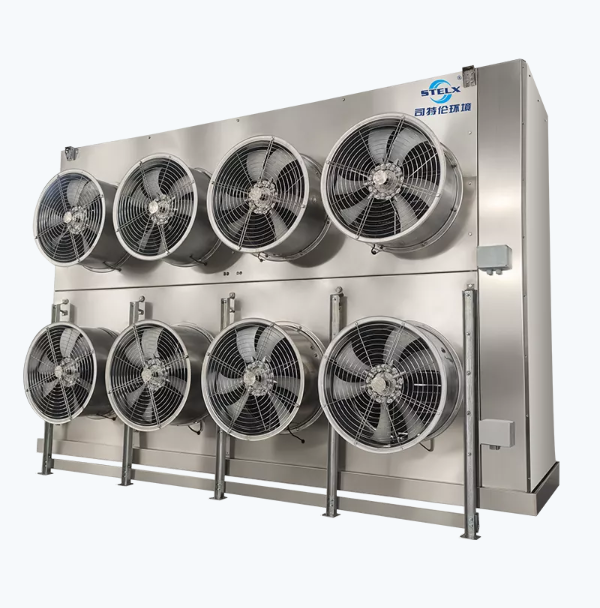
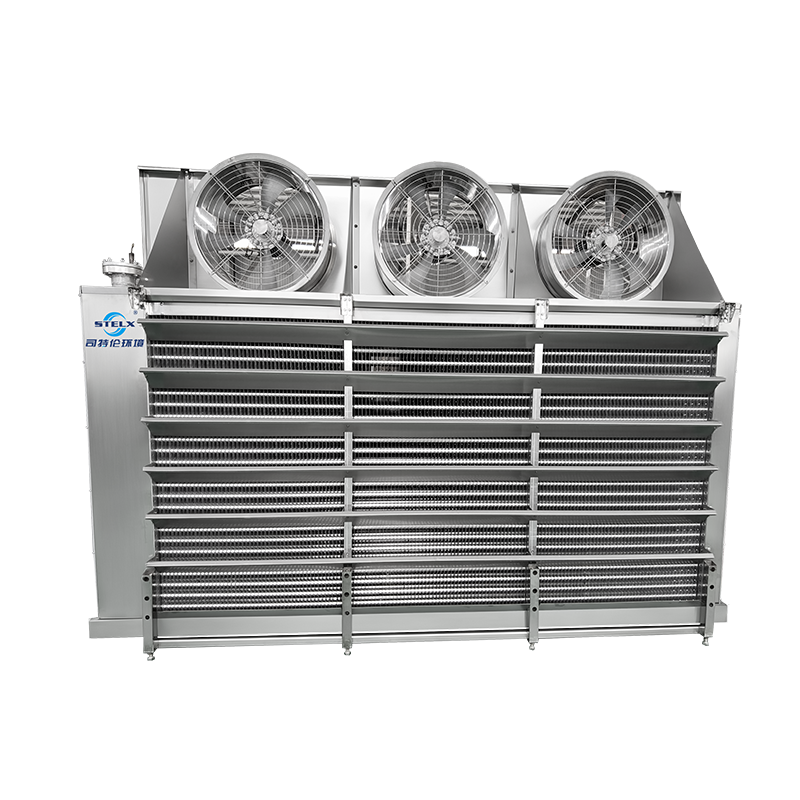
At STELX, industrial evaporator selection is approached as an application-specific engineering process.
Rather than treating the required cooling capacity as the only selection parameter, the design can be adapted to the project's refrigerant, operating temperatures, installation space, airflow requirements, materials, and defrost strategy.
For demanding applications, this flexibility allows the evaporator to be configured around the operating conditions instead of forcing the operating conditions to fit a standard product.
A technically useful inquiry should provide more than a target capacity.
For an accurate industrial evaporator selection, the following information is particularly valuable:
Information | Why it matters |
|---|---|
Room dimensions and design temperature | Establishes installation conditions and room geometry |
Product type, entry temperature, and throughput | Defines product cooling requirements |
Required cooling or freezing time | Determines the capacity needed within the available period |
Refrigerant or secondary coolant | Determines heat exchanger and circuit design |
Evaporating temperature or fluid inlet/outlet conditions | Establishes the thermal driving force |
Available installation space | Constrains coil and casing dimensions |
Door operation and humidity conditions | Helps assess infiltration and frost formation |
Required defrost method | Influences coil construction and operating cycle |
Air distribution requirements | Guides fan selection and unit positioning |
Material or hygiene requirements | Guides tube, fin, and casing selection |
Not every project will have all these details available at the initial inquiry stage.
However, the more clearly the operating requirements are defined, the more meaningful the equipment quotation becomes.
A manufacturer should also identify missing assumptions rather than presenting a precise-looking capacity based on incomplete information.
When reviewing competing quotations, buyers should look beyond the stated kilowatt capacity.
The most useful comparison includes:
Thermal performance: Is the quoted capacity based on the same air temperature, refrigerant conditions, and rating assumptions?
Air-side performance: What are the airflow rate, fan power, face velocity, and relevant air pressure losses?
Refrigerant-side performance: Are the circuit design, pressure drop, and operating conditions appropriate for the system?
Operating reliability: How will frost accumulation and defrost affect the unit's performance?
Mechanical suitability: Are the materials, construction, dimensions, and service access appropriate for the installation?
Lifecycle considerations: Does the selection balance initial cost, energy consumption, maintenance, and operational flexibility?
Two industrial evaporators with the same nominal capacity may differ considerably in these respects.
The lowest price per rated kilowatt is not necessarily the lowest-cost solution over the life of the installation.
Start with a refrigeration load calculation covering transmission, infiltration, product cooling or freezing, internal heat gains, and relevant process loads. Then account for the required cooling period and operating interruptions. Select the evaporator using its capacity at the actual design conditions rather than relying solely on catalogue ratings.
No. They describe different equipment performance characteristics, although both must be compatible at the system operating point. Compressor capacity depends on factors including refrigerant, evaporating temperature, condensing temperature, and operating conditions. Evaporator capacity depends on its thermal design, airflow, refrigerant conditions, and other factors.
No. A 100 kW rating applies to specified conditions. Changes in temperature difference, refrigerant operating conditions, airflow, or coil condition can change the available capacity.
There is no universal percentage suitable for every industrial application. The margin should reflect identified uncertainties, operating requirements, and the assumptions already included in the load calculation. Applying multiple undocumented safety factors can lead to unnecessary oversizing.
In low-temperature applications, frost accumulation can increase thermal resistance and restrict airflow. Changes in room conditions, refrigerant supply, and fan performance may also affect capacity. The cause should be established from operating data rather than assumed.
It can when the project has requirements that standard configurations do not address effectively. Custom coil geometry, refrigerant circuiting, fan arrangements, materials, and defrost design can help match the evaporator to the application. The benefit depends on the actual operating conditions and should be demonstrated through engineering selection.
Industrial evaporator sizing is not a simple exercise in matching the room load to a catalogue capacity.
A reliable selection begins with understanding how heat enters the room, when it must be removed, and how the evaporator will perform under the project's actual operating conditions.
The critical question is not:
“Does this unit cooler have enough nominal kilowatts?”
It is:
“Can this evaporator deliver the required cooling performance, under the specified operating conditions, throughout the required operating cycle?”
That distinction is fundamental to reliable industrial refrigeration design.
Whether you are designing a new cold storage facility, upgrading an existing refrigeration system, or selecting evaporators for a demanding food processing application, accurate equipment selection starts with clear operating data.
STELX manufactures customized industrial air coolers and evaporators for a wide range of refrigeration applications, with configurable heat exchanger materials, refrigerant circuits, fan arrangements, dimensions, and defrost systems.
Send us your room conditions, refrigerant details, cooling requirements, and installation constraints. Our engineering team can review the application and help develop a suitable evaporator configuration.
Website: https://www.stelxtech.com