Views: 0 Author: Site Editor Publish Time: 2026-07-24 Origin: Site
A refrigeration contractor once described a problem that initially seemed difficult to explain.
Two freezer rooms had almost identical dimensions. They operated at approximately the same room temperature and used the same refrigeration system. The evaporators were the same model, with the same coil configuration, fin spacing, and fans.
Yet after several days of operation, one room developed noticeably more frost than the other.
The customer naturally suspected the equipment.
Was one evaporator underperforming? Was the expansion valve incorrectly adjusted? Was there a problem with refrigerant distribution?
The investigation eventually showed that neither evaporator had a manufacturing defect.
The difference was in how the rooms were being used.
One room had relatively little traffic and stored sealed frozen products. The other was connected directly to a production area, had frequent door openings, and received products carrying significantly more surface moisture.
The two rooms looked identical on the refrigeration drawing.
They were not identical from an engineering perspective.
This distinction is important when selecting an industrial air cooler. A cold room evaporator does not operate in isolation. Its real operating environment includes the building envelope, doors, products, personnel, airflow, humidity, and defrost system.
That is why two apparently identical cold rooms can produce completely different frost patterns.
When operators see frost covering an evaporator, the first instinct is often to ask how to remove it.
The more useful question is:
Why is so much moisture reaching the evaporator in the first place?
Frost forms when moisture from the air reaches a surface below freezing. In a freezer, the evaporator coil is naturally one of the coldest surfaces in the room.
The process is straightforward:
Moist air enters the cold room.
Water vapor travels with the air toward the evaporator.
Moisture condenses on the cold coil surface.
Because the surface temperature is below freezing, the moisture freezes.
Frost gradually builds between the fins.
Airflow resistance increases.
Heat transfer and cooling performance begin to deteriorate.
The important point is that the evaporator is often simply where the problem becomes visible.
The source of the moisture may be somewhere else.
A surprisingly common approach to evaporator selection is to start with the room temperature and immediately choose a standard fin spacing.
For example, an engineer might broadly classify applications as:
High-temperature cold room
Medium-temperature cold room
Low-temperature freezer
This classification is useful, but it is not enough to determine the optimum evaporator design.
Consider two rooms operating at -25°C.
The first room stores packaged frozen food.
The doors remain closed most of the time. Products are already frozen before entering the room. Forklift traffic is limited.
The second room is part of a seafood processing facility.
Fresh product enters continuously. Employees move between areas. Loading doors are frequently opened. Cleaning operations introduce additional moisture.
The room temperature is identical.
The refrigeration capacity may even be similar.
But the moisture load can be dramatically different.
The second room may therefore require a different approach to:
Fin spacing
Coil surface area
Airflow
Defrost frequency
Defrost method
Door management
This is why a good cold storage evaporator should be selected according to the complete application rather than a single temperature setpoint.
Refrigeration load calculations typically receive considerable attention.
Moisture load sometimes receives much less.
That can be a costly mistake.
In industrial facilities, moisture can enter through many pathways:
Frequently opened doors
Loading docks
Personnel traffic
Wet floors
Washdown procedures
Fresh products
Warm packaging
Poorly sealed doors
Air leakage through building openings
Every kilogram of water that enters a freezer represents additional work for the refrigeration system.
But the effect is not limited to refrigeration capacity.
The moisture also becomes a frost-management problem.
This is particularly important in food processing facilities, where room doors may open dozens or hundreds of times during a production shift.
Another assumption worth challenging is that frost develops evenly over the entire evaporator.
In practice, it often does not.
Air entering an evaporator can have different temperature and moisture characteristics depending on where it comes from.
Some areas of the coil may therefore encounter a higher moisture load than others.
Air distribution around the room can also influence the result.
For example, if humid air from a frequently opened doorway is carried directly toward one section of the evaporator, that section may frost substantially faster than the rest of the coil.
This creates an important operational problem.
The evaporator does not need to be completely blocked before performance starts to decline.
A partially frosted coil can already have:
Higher air-side pressure drop
Reduced airflow
Lower heat transfer
Uneven room temperatures
Increased fan energy consumption
This is one reason visual inspections sometimes underestimate the effect of frost.
When discussing industrial air coolers, cooling capacity usually receives the most attention.
But capacity and airflow cannot be separated.
An evaporator transfers heat from the room air through the coil.
If airflow falls, heat transfer falls with it.
As frost accumulates between the fins, the available passage for air becomes smaller. The fan must overcome increasing resistance, and the volume of air passing through the coil can decrease.
The result can become a chain reaction:
Frost → higher resistance → lower airflow → lower heat transfer → longer compressor operation → higher energy consumption.
Eventually, the room may begin to develop temperature differences.
Operators may then lower the thermostat in an attempt to compensate.
That can make the situation worse by keeping the evaporator surface colder and potentially increasing frost accumulation.
The original problem was airflow.
The corrective action accidentally increased the refrigeration burden.
When airflow is insufficient, the obvious solution appears to be installing a larger or faster fan.
Sometimes that works.
Sometimes it creates a different problem.
Higher air velocity can increase:
Fan power consumption
Noise
Product dehydration
Air pressure drop
Air movement over wet product surfaces
In some applications, simply increasing fan capacity is therefore the wrong solution.
The real objective is appropriate airflow distribution.
A properly engineered industrial unit cooler should deliver enough air to maintain temperature uniformity without creating unnecessary air velocity.
This is particularly important in food processing and fresh-product applications.
Fin spacing is closely related to frost performance.
Narrower fin spacing increases heat transfer surface area and can allow a relatively compact coil to achieve substantial capacity.
The disadvantage becomes obvious when frost starts accumulating.
A small amount of frost can significantly restrict a narrow passage.
Wider fin spacing gives frost more room to accumulate before airflow becomes severely restricted.
But wider spacing also means fewer fins and potentially less heat transfer surface area within the same coil dimensions.
Neither option is automatically better.
The appropriate choice depends on the operating environment.
Engineers should consider:
Room temperature
Evaporating temperature
Relative humidity
Door opening frequency
Product moisture
Defrost strategy
Air velocity
Required operating cycle
This is one reason customized industrial evaporator design can be valuable for demanding applications.
A refrigeration system does not simply need an evaporator.
It needs an evaporator that can recover its performance efficiently after frost accumulation.
Defrost therefore belongs in the original design discussion.
Common defrost methods include:
Off-cycle defrost
Electric defrost
Hot-gas defrost
Water defrost
The appropriate method depends on the application and system architecture.
For example, a low-temperature freezer with significant moisture infiltration may require a much more aggressive defrost strategy than a relatively dry storage room.
But more defrost is not automatically better.
Excessive or unnecessarily long defrost cycles can:
Waste energy
Increase room temperature
Increase product temperature
Extend compressor recovery time
Increase operating costs
The objective is to remove enough frost to restore coil performance without wasting energy.
One useful way to evaluate defrost is to look at the evaporator's performance before and after the cycle.
Suppose the air cooler operates normally immediately after defrost.
Over several hours:
Airflow gradually decreases
Supply air temperature changes
Room temperature becomes less uniform
Compressor runtime increases
If this pattern repeats every cycle, the evaporator may be reaching a point where frost is significantly affecting performance before the scheduled defrost begins.
That is valuable information.
It suggests that the defrost interval, fin spacing, airflow, or moisture management may need to be reconsidered.
In other words, defrost should be evaluated as part of the complete operating cycle—not as an isolated maintenance function.
Consider two hypothetical freezer rooms.
Parameter | Room A | Room B |
|---|---|---|
Room temperature | -25°C | -25°C |
Evaporator | Identical | Identical |
Product | Packaged frozen food | Fresh seafood entering production |
Door traffic | Low | High |
Moisture load | Low | High |
Frost accumulation | Moderate | Heavy |
Defrost demand | Lower | Higher |
If both rooms use the same air cooler, the equipment itself is not necessarily wrong.
The design assumptions are simply different.
Room B may require:
Wider fin spacing
Greater coil surface area
Different fan selection
More carefully controlled defrost
Better door management
Improved airflow distribution
This is where an experienced evaporator manufacturer can provide value.
The goal is not merely to sell a larger air cooler.
The goal is to identify which variable is actually limiting performance.
When an evaporator develops abnormal frost, replacing the unit should rarely be the first troubleshooting step.
A more systematic investigation should examine:
How often is the door opened?
How long does it remain open?
Is there an air curtain or strip curtain?
What temperature does the product enter at?
Is the product wet?
Does it release moisture?
Is there significant air infiltration through openings?
Does the coil actually defrost completely?
Is ice remaining in the coil after the cycle?
Are all fans running correctly?
Is airflow consistent across the evaporator?
Is the frost pattern uniform?
Are certain sections blocked more quickly?
This approach often identifies the actual cause much faster than replacing refrigeration components one by one.
Not every cold room requires a customized evaporator.
A standard unit may be perfectly suitable when:
Room conditions are stable
Humidity is relatively low
Product characteristics are predictable
Door traffic is limited
Refrigerant conditions match standard equipment
Customization becomes more valuable when the project has unusual requirements.
Examples include:
Very low-temperature freezers
High-humidity food processing rooms
Large seafood facilities
Frequent door openings
Unusual room geometry
Long air-throw requirements
Special defrost requirements
Natural refrigerants
Corrosive environments
In these cases, customization may involve much more than changing the physical dimensions.
Engineers may need to optimize the entire air cooler:
coil → fin spacing → refrigerant circuit → fan → airflow → defrost → installation environment.
A less experienced approach is often:
Determine cooling capacity → select catalog evaporator → install → adjust controls.
An engineering-driven approach is different:
Understand the application → calculate the actual load → evaluate moisture and airflow → select fin spacing → design the coil → select fans → evaluate defrost → review installation → commission and observe actual performance.
The second process takes more effort at the beginning.
But industrial refrigeration equipment may operate for 10, 15, or even 20 years.
A small improvement during design can therefore have a substantial effect over the equipment's lifetime.
For a manufacturer, customized evaporator design requires more than a product catalogue.
It requires an understanding of:
Heat transfer
Refrigerant flow
Airflow
Frost formation
Defrost
Materials
Fan performance
Installation conditions
This is particularly important when supplying equipment internationally.
A cold storage contractor in Europe may have completely different requirements from a seafood processor in the Middle East or a frozen food facility in North America.
The equipment should therefore be adapted to the project—not simply shipped from a standard catalogue.
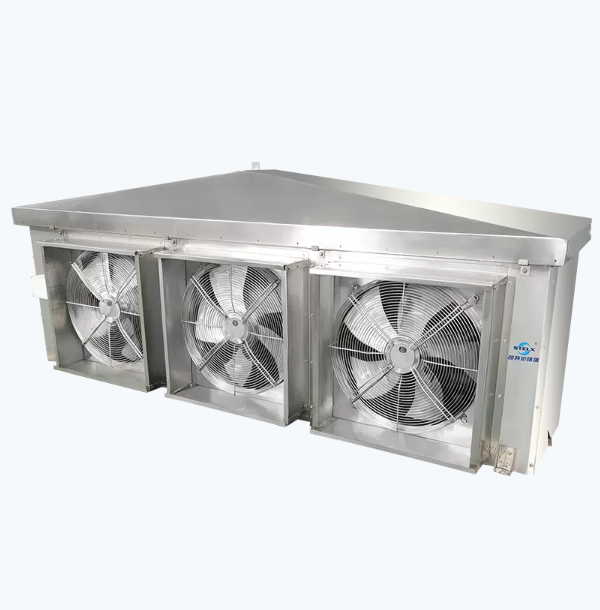
At STELX, this is the principle behind our approach to customized industrial air coolers. Coil dimensions, fin spacing, fan configuration, materials, refrigerant compatibility, and defrost requirements can be considered together according to the actual application.
The objective is not to maximize the specification of one individual component.
It is to achieve a balanced refrigeration solution.
The most important lesson is simple:
Two cold rooms with identical refrigeration equipment do not necessarily have identical operating conditions.
When investigating frost problems, consider the entire system.
Room temperature alone does not determine frost load.
Humidity and air infiltration can be critical.
Door traffic has a direct influence on moisture entering the room.
Frost reduces airflow before the coil appears completely blocked.
Fin spacing should be selected according to the application.
Increasing fan speed is not always the correct solution.
Defrost should be designed together with the evaporator.
Product characteristics can significantly influence evaporator performance.
Custom air cooler design becomes more valuable as operating conditions become more demanding.
The best industrial refrigeration systems are rarely the ones with the largest components.
They are the ones where the components have been correctly matched to the real operating environment.
A correct room temperature does not mean the moisture load is under control. Frequent door openings, wet products, high humidity, air infiltration, or incomplete defrost can all cause excessive frost.
No. Wider fin spacing does not prevent frost formation. It provides more space for frost to accumulate before airflow becomes severely restricted.
It can. Excessive airflow may increase fan energy consumption, noise, and product dehydration. The correct airflow depends on the application and room design.
There is no universal interval. The appropriate defrost frequency depends on moisture load, evaporator design, operating temperature, door traffic, and frost accumulation.
Not necessarily. First investigate door operation, humidity, product moisture, fan performance, defrost effectiveness, refrigerant conditions, and airflow distribution.
Customization is particularly useful when a project has unusual temperature or humidity conditions, high door traffic, special refrigerant requirements, long air-throw requirements, unusual room geometry, or demanding food-processing conditions.
Choosing an evaporator based only on cooling capacity can lead to problems later.
For a new cold storage or food-processing project, it is useful to evaluate the complete application:
Room dimensions
Room temperature
Required evaporating temperature
Refrigerant
Product type
Product entering temperature
Product throughput
Humidity
Door opening frequency
Defrost method
Required air throw
At STELX, we design customized industrial air coolers and evaporators around the actual operating conditions of each project. This approach allows the coil, fin spacing, fan configuration, materials, refrigerant circuit, and defrost requirements to be considered as one system rather than as isolated specifications.
For refrigeration contractors, OEM customers, and industrial cold storage projects, that difference can have a significant impact on long-term performance.